
7 Steps to Find Patient-Centered Primary Care
How to find a primary care clinician who listens, shares decisions with you, and stays with you over time.


Quick summary
Patient-centered primary care means your clinician listens first, explains your options clearly, and makes decisions with you based on your goals and values. To find it, look for a licensed clinician who offers access that fits your life (such as video visits or care in your language), shares decisions with you, and stays with you over time. A long-term relationship with the same primary care clinician is associated with fewer emergency hospital admissions and lower mortality.1
- Clear, honest communication and a clinician who speaks your language make shared decisions easier.2
- Video primary care has been found comparable to in-person visits for managing diabetes, high blood pressure and cholesterol.3
- Care from advanced practice nurses, such as nurse practitioners, is linked to higher patient satisfaction and fewer hospital readmissions.4
- Telehealth works best as part of an ongoing relationship, with in-person care when needed.5
How this guide was written: evidence-based practice
Finding a primary care clinician you trust can feel harder than it should. Long waits, rushed visits and confusing bills leave many people feeling unheard. This guide walks you through seven practical steps to find care that puts you at the center.
The guidance follows evidence-based practice: combining the best available research with clinical expertise and each patient's own values and preferences.6 Care that follows evidence-based practice is linked to better patient outcomes.7 Each clinical point is tied to a peer-reviewed study from the last five years, with numbered references at the end.
What is patient-centered primary care?
Patient-centered primary care is care built around you: your goals, your daily life, your culture and your preferences. Your clinician is your partner, not just the person who gives orders.
A key part of it is shared decision-making. That means your clinician explains the options, including the benefits, risks and trade-offs, and you choose together. A 2025 review of shared decision-making in primary care found that it works best when clinicians communicate clearly and honestly, speak the patient's language, and give patients room to ask questions.2 The same review found that language and cultural mismatch, bias, mistrust and rushed visits get in the way.2
In practice, patient-centered care looks like:
- Visits that leave time for your questions
- A clinician who asks about your goals before giving advice
- Treatment plans you help build
- Follow-up that checks whether the plan is working
- Clear information about costs and next steps
Why does a long-term primary care relationship matter?
Seeing the same clinician over time, called continuity of care, is one of the strongest signs of good primary care. A national study of more than 4.5 million people in Norway found that the longer patients stayed with the same primary care physician, the lower their odds of using after-hours care, being admitted to the hospital urgently, or dying during the study year.1 This was an observational study, so it shows an association rather than proof of cause, but the pattern grew stronger with each added year of the relationship.1
A clinician who knows your history can notice changes sooner, avoid repeat tests, and understand what matters to you. That is why choosing a primary care home is worth the effort.
What are the 7 steps to find patient-centered primary care?
Use these steps to compare practices before you commit.
1. Know what you need
Write down your health concerns, your current medications, and what you want from a primary care clinician. Do you need help managing a long-term condition, preventive care, or someone you can reach quickly when something comes up?
2. Check that access fits your life
Look at visit types (video or in person), available hours, and languages spoken. A clinician who speaks your language makes it easier to share decisions.2 If you prefer Spanish, look for bilingual or Spanish-speaking telehealth (telemedicina en español).
3. Confirm credentials and licensing
Primary care can be provided by physicians, physician assistants and nurse practitioners. A meta-analysis of randomized trials found that care from advanced practice nurses was associated with lower health care costs, fewer hospital readmissions and higher patient satisfaction compared with other health professionals.4 A scoping review found similar results in primary care, including fewer emergency department visits in most studies.8 Whoever you choose, check their license. Our guide explains how to verify a telehealth provider's credentials.
4. Ask how decisions are made
Ask, "How do you involve patients in treatment decisions?" Listen for answers about explaining options, risks and trade-offs, and respecting your choices.
5. Ask about follow-up and communication
Find out how you will get test results, how to send a message between visits, and how soon follow-up visits are available. Good follow-up supports the continuity that is linked to better outcomes.1
6. Understand costs and coverage
Ask for visit prices up front and check how your insurance works with the practice. For a step-by-step method, see 7 steps to check if telehealth primary care is covered.
7. Judge the first visit
After your first appointment, ask yourself: Did I feel heard? Were my options explained clearly? Do I know the plan and the next step? If the answer is no, it is reasonable to look for a better fit.
| Step | What to look for | Why it matters |
|---|---|---|
| Access | Video visits, hours, your language | Makes ongoing care practical |
| Credentials | Active license where you are located | Safe, legal care |
| Shared decisions | Options explained, your goals respected | Plans you can stick with |
| Follow-up | Clear way to reach the practice | Supports continuity |
| Costs | Prices and coverage explained up front | No surprise bills |
Can telehealth primary care be patient-centered?
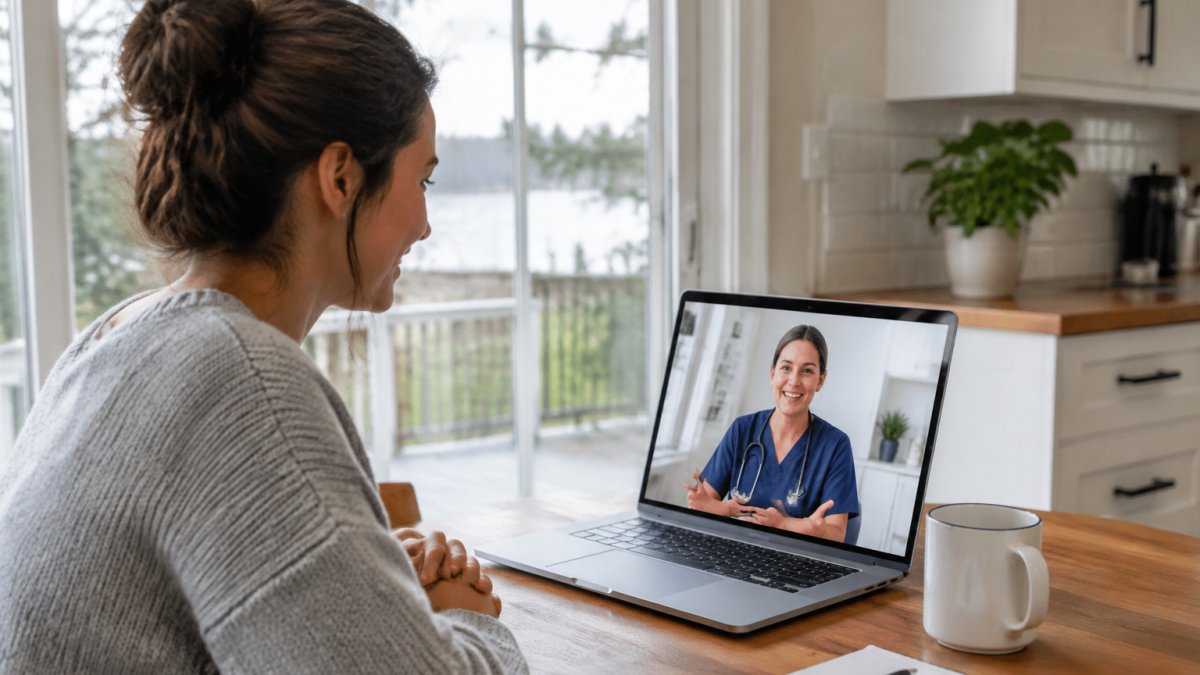
Yes, when it is part of an ongoing relationship. A systematic review of primary care found that video and phone visits led to similar or fewer emergency department visits and hospital visits, and fewer tests and imaging, compared with face-to-face care, though the studies had limits.9 Another review found that for diabetes, high blood pressure and high cholesterol, telemedicine visits with a primary care clinician were not inferior to in-person visits.3
The Society of General Internal Medicine recommends using telemedicine for limited acute problems or together with in-person services to extend long-term care relationships, and choosing the visit type through shared decision-making between patient and clinician.5 In other words, the best telehealth practices tell you clearly when a problem needs an in-person exam, lab test or imaging, and help you get it.
Good to know: Telehealth is not right for every condition. Chest pain, trouble breathing, signs of stroke or any other emergency need 911, not a video visit.
What questions should I ask a new primary care provider?
Bring a short list to your first visit or call. Clear, specific answers are a good sign.
- How do you involve patients in treatment decisions?
- How can I reach you between visits, and how fast do you reply?
- What happens if my plan is not working?
- When would you send me for an in-person exam, labs or a specialist?
- Can I be seen in Spanish (or my preferred language)?
- What will my visit cost, and how is insurance handled?
How Tonies Health can help
I'm Lucas Tonies, MSN, APRN, FNP-C, CCRN, a board-certified family nurse practitioner, and I provide telehealth primary care by secure video. Every visit starts with listening: your concerns, your goals and your daily life. Then we build a plan together, and I help arrange labs or in-person care when you need them.
A New Patient Visit is $150, a visit for 2 to 3 concerns is $200, and a complex visit is $250. See all fees on the pricing page. Insurance and coverage details are confirmed in the patient portal when you book. Medicaid is not accepted. Visits are available to patients located in California and 8 other states (Arizona, New Mexico, Wyoming, Washington, Florida, Virginia, Ohio and New York), in English and Spanish (se habla español). Learn more about our evidence-based approach.
For emergencies, call 911.
Book through the new patient portal
Frequently asked questions
What does patient-centered primary care mean?
It means your goals, values and preferences guide your care, and you make decisions together with your clinician. Clear, honest communication and a clinician who speaks your language support this kind of shared decision-making.2
Can telehealth replace in-person primary care?
For many routine and chronic care needs, video visits work well and have been found comparable for diabetes, blood pressure and cholesterol care.3 Experts recommend using telehealth alongside in-person care when an exam, test or procedure is needed.5
Is a nurse practitioner a good choice for primary care?
Research supports it. A meta-analysis of randomized trials linked advanced practice nurse care with higher patient satisfaction, fewer readmissions and lower costs.4 Always confirm your clinician's license where you are located.
Why does it matter if I see the same clinician every time?
A long relationship with the same primary care clinician is associated with fewer urgent hospital admissions and lower mortality.1 Your clinician gets to know your history and what matters to you.
References
Sources are peer-reviewed research and National Institutes of Health (NIH) resources published within the last five years, formatted in APA 7th edition. Numbers in the text link to each source.
- Sandvik, H., Hetlevik, Ø., Blinkenberg, J., & Hunskaar, S. (2022). Continuity in general practice as predictor of mortality, acute hospitalisation, and use of out-of-hours care: A registry-based observational study in Norway. British Journal of General Practice, 72(715), e84–e90. https://doi.org/10.3399/BJGP.2021.0340 PubMed (NIH): https://pubmed.ncbi.nlm.nih.gov/34607797/ ↩ ↩ ↩ ↩ ↩
- Anaya, Y., Do, D., Christensen, L., & Schrager, S. (2025). Shared decision making among racially and/or ethnically diverse populations in primary care: A scoping review of barriers and facilitators. Annals of Family Medicine, 23(2), 108–116. https://doi.org/10.1370/afm.240087 PubMed (NIH): https://pubmed.ncbi.nlm.nih.gov/40127976/ ↩ ↩ ↩ ↩ ↩
- Mabeza, R. M. S., Maynard, K., & Tarn, D. M. (2022). Influence of synchronous primary care telemedicine versus in-person visits on diabetes, hypertension, and hyperlipidemia outcomes: A systematic review. BMC Primary Care, 23(1), Article 52. https://doi.org/10.1186/s12875-022-01662-6 PubMed (NIH): https://pubmed.ncbi.nlm.nih.gov/35313804/ ↩ ↩ ↩
- Fajarini, M., Setiawan, A., Sung, C. M., Chen, R., Liu, D., Lee, C. K., Niu, S. F., & Chou, K. R. (2025). Effects of advanced practice nurses on health-care costs, quality of care, and patient well-being: A meta-analysis of randomized controlled trials. International Journal of Nursing Studies, 162, Article 104953. https://doi.org/10.1016/j.ijnurstu.2024.104953 PubMed (NIH): https://pubmed.ncbi.nlm.nih.gov/39586168/ ↩ ↩ ↩
- Chen, A., Ayub, M. H., Mishuris, R. G., Rodriguez, J. A., Gwynn, K., Lo, M. C., Noronha, C., Henry, T. L., Jones, D., Lee, W. W., Varma, M., Cuevas, E., Onumah, C., Gupta, R., Goodson, J., Lu, A. D., Syed, Q., Suen, L. W., Heiman, E., . . . Schmidt, S. (2023). Telehealth policy, practice, and education: A position statement of the Society of General Internal Medicine. Journal of General Internal Medicine, 38(11), 2613–2620. https://doi.org/10.1007/s11606-023-08190-8 PubMed (NIH): https://pubmed.ncbi.nlm.nih.gov/37095331/ ↩ ↩ ↩
- Dusin, J., Melanson, A., & Mische-Lawson, L. (2023). Evidence-based practice models and frameworks in the healthcare setting: A scoping review. BMJ Open, 13(5), Article e071188. https://doi.org/10.1136/bmjopen-2022-071188 PubMed (NIH): https://pubmed.ncbi.nlm.nih.gov/37217268/ ↩
- Connor, L., Dean, J., McNett, M., Tydings, D. M., Shrout, A., Gorsuch, P. F., Hole, A., Moore, L., Brown, R., Melnyk, B. M., & Gallagher-Ford, L. (2023). Evidence-based practice improves patient outcomes and healthcare system return on investment: Findings from a scoping review. Worldviews on Evidence-Based Nursing, 20(1), 6–15. https://doi.org/10.1111/wvn.12621 PubMed (NIH): https://pubmed.ncbi.nlm.nih.gov/36751881/ ↩
- Horton, M., Dixon, J., Turi, E., Balusu, C., Paikoff, R., Maier, C. B., & Poghosyan, L. (2025). Advanced practice nurses in primary care and their impact on health service utilisation, costs and access globally: A scoping review. Journal of Clinical Nursing, 34(5), 1592–1601. https://doi.org/10.1111/jocn.17614 PubMed (NIH): https://pubmed.ncbi.nlm.nih.gov/39654015/ ↩
- Bracken, K., Salerno, J., & Yang, L. (2025). Physician-led synchronous telemedicine compared to face-to-face care in primary care: A systematic review. Evaluation & the Health Professions, 48(3), 279–290. https://doi.org/10.1177/01632787241273911 PubMed (NIH): https://pubmed.ncbi.nlm.nih.gov/39140652/ ↩
Comments
No comments yet. Share a thought or a question about this topic.
Comments appear right away, so please keep them respectful and general: don't share personal medical details or contact information, and this isn't the place for medical advice about your own situation. Comments that break these rules may be removed. If you have a health concern, book a visit or talk with your own clinician. In an emergency, call 911. For a mental health crisis, call or text 988.